

I say “some.” For example, my colleague at Cato, the Englishman Ryan Bourne, does. My friend at Aix-Marseille University, the Frenchman Pierre Garello, does. We are serious people, willing to listen to reason and facts. We are devoted to finding and then announcing truths. We do not believe out of what our opponents call “fundamentalism,” that is—to insult some believing Christians, by the way, out of irrational motives having no basis in scientific reason and fact.
The rest of the economists—yes, even the economists—do not believe that supply and demand work pretty much as you might expect, even if you never studied economics. They believe, on the contrary, that many, many “imperfections” make the economy work extremely badly—so badly that wise economists from USP need to step in to offset the stupid way that markets of supply and demand work. They say that there are permanent monopolies, great external effects, strong tendencies to mass unemployment. The list goes on and on. I once compiled a list and, with little trouble, could think of fully 108 “imperfections” imagined on the blackboard by economists and anti-economists. The trouble is that the economists from USP, or MIT or the LSE, and certainly not the anti-economists, haven’t troubled to give the slightest evidence that the imperfections are important. They merely snort indignantly that it’s just obvious that they are big.
Like fundamentalists, yes?
Well, why do I, after 84 years on this planet (on September 11, thanks), most of it spent thinking about the evidence on how economies work, disagree with the numerous non-believers?
For one thing, as a resident of an economy, I live daily inside a massive experiment proving that it does work pretty much as supply and demand says. So do you live inside it. São Paulo is an enormous city. It exhausts me to drive across it. Yet somehow every day when you go to get a morning coffee, there it is. When you want to buy a new shirt, there it is. If you had the misfortune to live in a country that so strongly denies market forces that it makes them illegal, such as North Korea or the old Soviet Union, this would not be the case. The Soviets made endless jokes about it not being the case.
For another, as an economic historian, I know, and can show you massive evidence, that liberated people become amazingly creative and then make themselves and everyone else amazingly rich. It has happened from 1776 to the present, I’ve told you frequently, to the extent of 25 thousand percent, for the first time in history. In a century or so, if the economists and politicians don’t intervene, everyone will be twice as rich as the average Swiss person now. I mean Africa. I mean everywhere.
For another, as an economist of a mathematical and philosophical bent, I have a vision of the economy as an enormous spontaneous order, like the Portuguese language or the history of art or even the pattern of your own sweet life.
It’s lovely. Let it work.
Weekly column in Folha de São Paulo, Brazil
Translated into Portuguese for the newspaper.
Since 1776, there has been a 3,000% explosion in the average real income per person in the world.
Nothing earlier came remotely close.
It was caused not by the usual suspects of investment or exploitation, but by liberty inspiring a flowering of human creativity—in the arts and sciences, and in the economy.
Though Brazilians and many other Latin Americans are uneasily aware that their economies lag some, and sometimes a lot, the Great Enrichment is nonetheless evident everywhere from the Border to Tierra del Fuego, from Santiago in Chile to Recife in Brazil.
The Latin Lag can be overcome. Brazil, like much of Latin America, needs essential liberalism to do it.
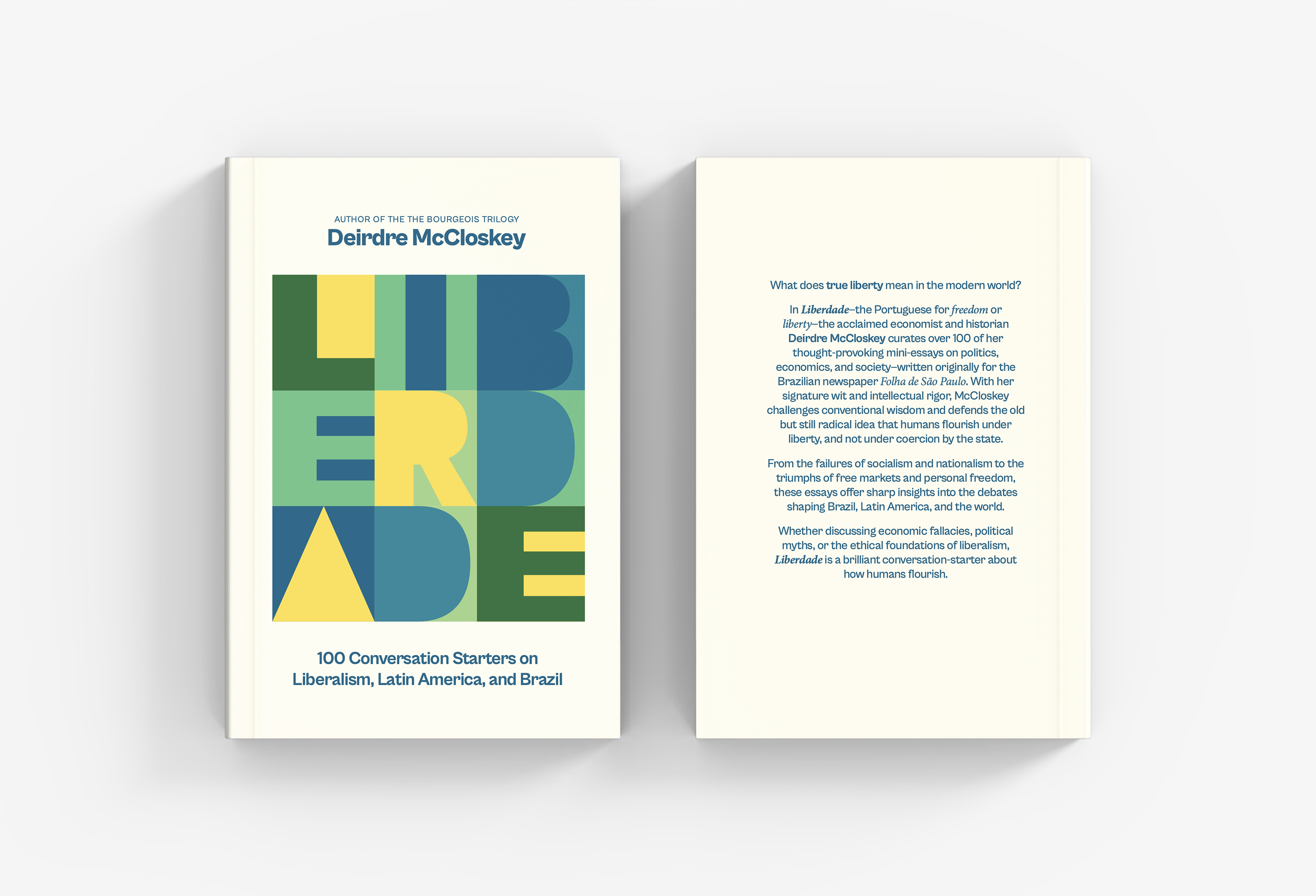
Check out my new book, Liberdade: 100 Conversation Starters on Liberalism, Latin America, and Brazil
I remember reading your book in high school in Africa. Crazy that I would see the day that you post articles online in real time.